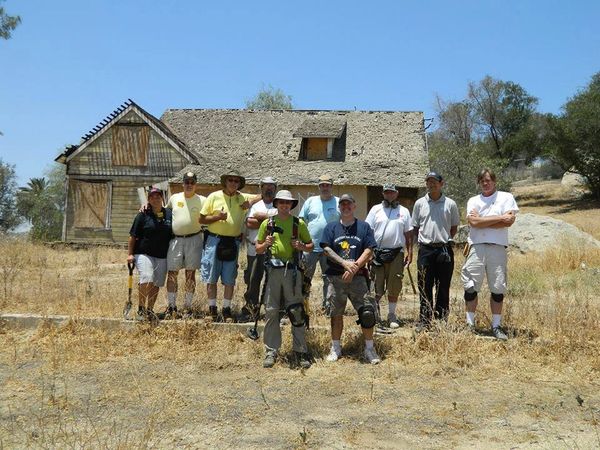
Hunting our parks can be very successful. But, because of irresponsible detectorists leaving un-filled holes and digging huge, unnecessary holes, more and more cities are not allowing us to hunt them anymore.
You don't need to dig a one foot diameter hole for what is probably a pull tab, a coin, a small piece of junk aluminum from a tin can ("canslaw"), or hopefully, a piece of gold jewelry.
Some detectorists just use a pointed probe to locate and recover a target. Others use a handheld digging tool.
Here's what you should do when using a handheld digging tool:
Pinpoint your target. Lay a small towel down next to the target. You can then dig the turf straight down to the depth your detector showed, and about 3" - 4" around your target. As you dig your circle, leave an uncut "hinge" section. Now you can merely fold back your plug of soil and place any loose dirt onto the towel, so you keep all the dirt together from the hole.
Run your pinpointer over the plug to see if your target is contained in it. Then, run it inside the hole to locate the target. Recover your target. Then scan the hole one more time to see if there are additional targets (i.e., coin spill). Do that each time a target is pulled from the same hole.
After you have confirmed there are no more targets in the hole, pull your towel from under the plug and shake any loose soil back into the hole. Then fold back the plug of grass/soil into the hole. Tamp the plug down so the plug is tight. This will ensure that the grass doesn't die and keeps growing.
Remember, we are stewards of the land. It is our responsibility to keep our hobby available to future generations by not getting our hunting locations shut down due to irresponsibility. Remember our Code of Ethics!

There are many different hand held digging tools. This one from "White's" is just an example. You can find them on metal detecting stores online.

The most important thing to remember is "Fill Your Holes".
An important "Gate Bar" earned!
Although the thrill of finding "treasure" is incredible, just as important to a metal detectorist, or should be, is when you are able to track down the owner so that "treasure" can be returned to him or her.
In RTHC, one of the 61+ gate bars a member can earn and wear with the rest of them is the "Found & Returned" gate bar. When a member does a found and returned, we ask they get a photo of the owner with the item. The member then writes up how they found the item, how the owner was tracked down, and the usually (tearful) reunion of item and owner. That write-up and photo are sent to the editor of our monthly newsletter, "The Treasure Trove" where it will be included in the next issue. At the next meeting, the member then shares with our members the same as he wrote up.
The club awards the member a silver half dollar as recognition of doing a good deed and providing a community service.
Some members take it a step further and join an international online organization called "TheRingfinders" (dot com) so that those that have lost an item, and they know approximately where it was lost (i.e., back yard/front yard, park, beach, etc), can call a detectorist in their area in a timely manner.


You wouldn't believe what lurks under the turf, sand, and surf!
Our members love to hunt the sands for "buried treasures". Coins, jewelry, cell phones, and more. But at the same time, you also find metallic trash that can be harmful to bare feet and kids playing, as well as the environment. At the beaches, as well as local parks, we regularly find the following: rusted tent stakes, rusty nails and screws, utensils- knives, forks, and spoons, pieces of hard wire, pull tabs, bottle caps, scissors, live/spent ammunition, rusty metal pieces, sharp aluminum can pieces, and broken glass. We don't know how some of these items make their way onto the sand or into the parks, but as metal detectorists, we believe we are caretakers of our land. That is why we always recover the "trash" as well as the "treasures" as our photo shows. This was all found at the beach! Our club abides by the "Metal Detectorist's Code of Ethics":
Besides finding pull tabs and all the other crazy items buried in the sand at the beach, our members come across a lot of forgotten eyewear. Reading glasses, sunglasses, we find it all. If we're not able to unite them back to the owner at that moment, and we're unable to identify an owner, members bring them to the next meeting where we have a bucket where they are deposited. Once the bucket is full enough for a transfer, one of our members takes them to an eyewear shop where they have a "Lions Club International" box for donations.
From the Lions Club International website:
"Deaf and blind from an early age, Helen Keller emerged as an outspoken activist, championing vision care for much of her life. In 1925, Helen Keller boldly called upon Lions to serve as Knights of the Blind — and Lions answered the call. Today, her influence still resonates loudly, as Lions continue to expand their vision service all over the world.
In 1990, Lions International introduced SightFirst, a program that enabled Lions, health care providers and partner organizations around the world to fight the major causes of preventable and reversible blindness and assist those who were blind or visually impaired. More than 544 million people have been impacted by vision service projects thanks to SightFirst Grants, and Lions continue to serve the blind and visually impaired."
This incredible international organization is helping millions to have better eye sight.
This is one way the members of the Riverside Treasure Hunters Club can be part of that.
If you are not a club member but would like to donate your used glasses to this worthy cause, feel free to come to one of our meetings and drop them off!


The Riverside Treasure Hunters Club strives to make the hobby of metal detecting fun and interesting. The club brings in speakers, has a Crime Scene Unit, and is restoring our Historical Preservation Unit. This allows our members to get involved with the community and put their skills to work.
Some members also belong to gold prospecting clubs and metal detect for gold nuggets in the desert or on club claims.

The dreaded PULL TAB!
Just when you thought you rang up that gold ring!
Pull tabs are the bane of all metal detectorists! But if you didn't know, they're GOLD to the families of hospitalized children far from home.
At a Ronald McDonald House, families can be together, enjoy home-cooked meals, and receive compassionate hospitality and support from staff and volunteers- all near the child's hospital.
Families who stay at a Ronald McDonald House report more positive hospital experiences and a greater ability to participate in their child's care.
The actual cost to operate a family-stay room varies between $50 and $100 a night. Families either stay at no cost or are asked to make a donation of $25 a day, depending on the house. However, payment is NEVER expected for those who cannot afford it. The difference is made up in donations.
Thanks to your contributions, it is a global RMHC policy that a family never be turned away because of their ability to pay.
The Riverside Treasure Hunters Club has been a proud supporter of the Inland Empire Ronald McDonald House for many years now. Members bag up their pull tabs and bring them to one of our meetings, where they are given to our Ronald McDonald House liaison, who then takes them in bulk to Ronald McDonald House. They then recycle the aluminum pull tabs and use the proceeds toward the House.
If a member digs/finds 1,000 pull tabs in the time between the last meeting and next meeting, that member is eligible for the "1,000 PULL TABS" gate bar
If you are not a club member but would like to donate your saved pull tabs to this worthy cause, feel free to come to one of our meetings and drop them off! You will be helping to ease a family's worries during a stressful time.
We're celebrating the Ramirez Family of Colton who have donated a total of 3,601pull tabs to the club over the last two years! They received grateful "Recognition" certificates that they can proudly display at home or office.


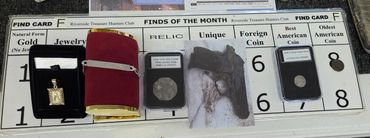
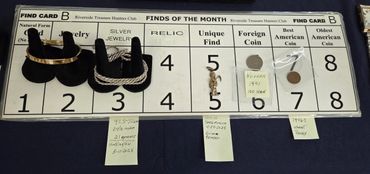
Our members show their "Finds" found between the last meeting and current meeting during the calendar year. (Note: Items found at one of our "seeded" hunts are ineligible to display. A "seeded" hunt is where the club purchases coins/tokens, etc and these items are "planted" at the beach or park outing for members to locate with their metal detectors. Some items are considered special and can be swapped for a prize.)
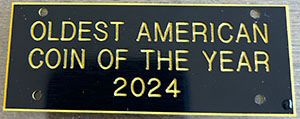
At the meeting, members vote on who has the best item for each category (Best Natural Gold, Best Jewelry, Best Silver Jewelry, Best Relic, Best Unique Find, Best Foreign Coin, Best American Coin, Oldest American Coin) and the winners earn a point for each category win.
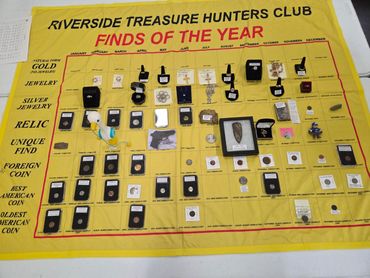
It also allows them to enter their winning items for that year into the "Finds of the Year" competition held at our January meeting, where members vote for the best item by the month it won from each category (see our yellow "Finds of the Year" blanket in the picture above). The winners of the "Finds of the Year" competition receive special items, such as a Silver Dollar and a certificate. They can also get a Gate Bar, which is explained later.
Also happening at the end of the year, the "Monthly Finds" winners' points are tallied and the member with the most points we name "Treasure Hunter of the Year", which earns them special items, such as 1 year's free membership, a trophy, a Silver Dollar, and a certificate.


Metal Detect any of the below items between the last meeting and current meeting, display them at the next meeting or show them to the Monthly Finds Chairperson, and receive that Gate Bar at the following meeting!


Copyright © 2026 Riverside Treasure Hunters Club - All Rights Reserved.
We use cookies to analyze website traffic and optimize your website experience. By accepting our use of cookies, your data will be aggregated with all other user data.